Tuesday, August 2, 2011

The Trouble with Tomatoes

Well, you know my thoughts on tomatoes if you have read any of my earlier postings on the subject.

Miguel, who arrived from Cental America, approaches growing tomatoes as the weeds they are in his tropical world and as I did when I first migrated from Trinidad.
He loves his tomato plants ....


He wisely kept them covered with a plastic sheet in the cooler, earlier months. I really like his support system ... a grid of interlocking bamboo posts. He planted many
tomato plants and close together. It reminded of the culture we come from, where we create from what we have before thinking of making a ready made purchase. An attitude that fosters ingenuity.

Cultural Sharing ....

These Grow Project sessions have been interesting on more than one level. I also enjoy the cultural exchanges that start our day. Our participants are from different parts of the world ... the Philipines, Japan, Cuba and Guatemala.


We start with a little refreshment ... Emiko brought a special Japanese snack and tea to share which results in interesting conversations around food from our different cultures.


Emiko was also very proud of the "kabu" turnips she grew and shared the best way to eat a fresh kabu is sliced thinly with a sprinkling of salt, sugar and rice wine. She prepared it in this traditional fashion and brought it for us to sample ... Yum!

Our youngest member ... Emma


A couple of weeks ago, Emma, who is home on holidays, discovered the Grow Project happening every Friday morning in her complex. That week she helped us plant cucumber plants and carrot seeds. Since then she has joined us and participated in what ever we are doing.

I think she is very lucky to have this opportunity to learn all the various aspects of growing food ...

The Grow Project ...

One thing leads to the next, they say....

I was approached at the beginning of this season to start working with residents of a Coop Housing. This complex has an ideal situation. A large central court yard with raised boxes. The boxes were cleaned up and new growing medium installed and then I began working with a few interested residents and committed volunteers already involved with an ongoing cooking program happening through the communal kitchen.

The Grow Project actually grew out of the Cooking Program with the intention of both growing organic veggies for this project and to support and share learning with residents who would like to grow food for themselves.


Despite the surrounding buildings blocking direct sunshine for much of the day many of the varieties we grew have flourished.


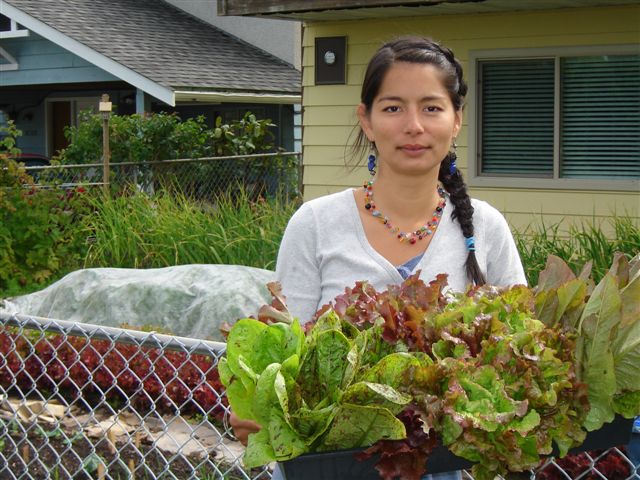
Our first harvest for the Community Kitchen. The volunteers look quite proud of the results.

Time to Catch Up ...

My last entry was November of 2010, so you be justified in thinking I had packed it all in ... not so ... I have been very busy ... just in different ways.

My Balcony Garden has moved next door to my neighbour, Craig as my balcony has been under repair for the last month ... summer maintenance in a town house. So not much happening there this year.

However, I am still doing Urban Agriculture through RUF (check the RUF Blog on the front page). I am still learning lots though the Sharing Farm where I manage the greenhouses and work with the volunteers.
This is the second year of growing food through South Arm Community Centre with teenage volunteers. This year, 2011 we started a new Urban Agriculture program called the Grow Project in a Coop Housing Complex.

So there is lots to share, both through the Richmond Urban Farmers (RUF) Blog and the Balcony Gardening Blog. which I will use for now for all my other activities. I will be updating both as I have the time ....

Monday, November 22, 2010

Urban Agriculture and our CSA

My other sphere of activity is Urban Agriculture and our very small, experimental CSA. Three of us started doing Urban Agriculture (growing food in other people's back yards) mid 2008 with the intention of learning how to grow our own food and how to pay for the experience by selling some of the shares of the food we are growing.

We continued the experience again this year and supplied between 4 and 12 shares of the harvest per week. We were able to grow a range of food: kale, swiss chard, radishes, beets, turnips, potatoes, lettuce, squash, zuccini, tomato, basil, peppers,carrots, beans, sugar snap peas and flowers.


The most labour intensive part was launching the gardens in the spring: weeding, fertilizing (lime, alfalfa pellets, rock phosphate and potash), rototilling, setting up climbing structures for the peas, plastic tunnels for the tomatoes, starting trays and trays of seedlings and planting. But ... once that was done, we did not do much else and the seedlings had to fend for them selves and outrun the weeds. When we began harvesting for the boxes, we organized the work load in a way that worked for each of us. I went in the day before and did the harvesting of most of that week's order and washed and bundled. Then the rest of the team harvested anything I did not get to and portioned out the shares and delivered.

Arzeena will be moving on next year. She has bought her farm and that will be her focus in the new year. Luc and I will carry on with one garden and will supply a smaller number of clients and our own needs.

I am very grateful for this experience of learning to be self sufficient in organically grown food. All in all I have found it to be a most rewarding experience.

The Steveston Farmers' Market

It is now impossible to cover one topic in this blog. I am finding that the interconnection between all my agricultural endeavours are becoming very entwined. Take the Steveston Farmers' Market as an example ....

What a great little market! I found myself there at quite a few of the markets this summer and for a variety of reasons. I was present at the first market for the season. I accompanied the student farmers and helped them set up their very first farmers' stall! For me the visual presentation is all important. Human beings love beauty! If you want to catch the customer's eye make your stall beautiful!


Label everything clearly and with prices ...


Offer a lovely range of fresh veggies and flowers of course ... we eat with our eyes first!


The Farmers' Market allowed me to first have an outlet for my "pain in the butt" tomato plants. Next when the pole beans began spitting beans out in great abundance, I was able to get up bright and early, run to the garden, pick beans ad nauseum, bundle them and take them to the market. They sold very well in deed. Folks know a deal when they see it. Imaging $2 a bundle for the freshest, tastiest beans ever! When we had a plethora of lettuce we were able to do the same ... to market, to market. That day I also harvested a lots of surplus basil expecting to have it snapped up. I was sorely disappointed. I had to go home and make lots of pesto which we shared between us. That buffered the disappointment.


... and our garlic. We grew and harvested lots of garlic this year. We had so much we had to divy it up between us to dry it.


Then I tried my hand at braiding the garlic and I took the braids to the market to sell. I am still trying to work out a price that people will pay. Customers are spoilt by cheap Chinese garlic and are not willing to fork out $20 for a braid of 10 large garlic. Maybe downtown but not in Richmond.


and I made a little label ...


So it is wonderful to have access to the collaborative booth of organic farming students. They have been very supportive of our little local agricultural efforts. I hope I have been able to serve them too in some small way.

2010 Growing Season in Review ...

What do you do as a gardener, when it is minus 3 and snow is on the ground?
You look at the photos you took during the year, see the photo of apple chips and remember there a few left in the cupboard and eat the rest of them ... Then you decide that you are not a very disciplined blogger and need to make up for failing to make any entries since spring by reviewing 2010 growing season ... if you can remember how.

I love Asian Greens

I really do. I have two experiences to tell of this year.
They were one of the first crops I grew on my balcony. I planted the gai lan closely in the boxes and they did not grow very tall before they began to bolt but they allowed me to harvest my dinner fresh and supplied me with about three meals.


By mid June I was harvesting a small variety of pac choi (patchoy), Toy choi, I do believe. The great thing about Asian Greens is they like the cooler weather so you can begin growing them very early in the season. I probably started them indoors in March planted them out as seedlings and was harvesting them about 5 weeks later. They are fast growers and you can eat the whole plant. What is more delicious and easy to cook than stir fried, freshly harvested baby patchoy? Even better because you grew them yourself. I swear they taste better when you grow them yourself! ... and in the compost from your own recycled veggie waste! On your balcony! Satisfaction on many levels ....


Growing Asian Greens as a Fall crop on the Sharing Farm ...

My other experience has been growing Asian Greens at the Sharing Farm where I work two days a week. The Farm supplies the Richmond Food Bank and a few of the local Community Meals run through different neighbourhood churches with fresh veggies grown using organic methods. Asian greens, particularly different varieties of patchoys have been a great way to extend the growing season. It is now November and again with about five weeks from seed to harvest we have pulled many pounds of patchoy out of the hoophouses and greenhouse. The only discouragement was finding small slugs tucked deep into the heart of the larger upright variety. Smart slugs.


The great Tomato Project of 2010

Well my verdict on that particular project would be probably not something I would undertake to do again. Just to recap ... I started and nurtured 75 tomato plants ... three heritage varieties. A lot of work! and a difficult project when you live in a town house with no decent sun exposure. I have to move tout bagage over to my Urban agriculture site when it came time to pot up 75 seedlings into 1 gallon pots. Then I had to set them up under plastic so they would not get early blight. And I had to find an efficient method of giving them their fish tea and water them. Then how the heck to you sell 75 1 gallon tomato plants to recoup your investment? Not on Craig's List! Did not work for me. I did manage to sell some of the plants at the Steveston Farmer's Market.


Lucky for me, this year, the first intake students studying Organic Farming on the Sharing Farm, ran a stall at the Steveston Farmers Market and I was able to link up with them in a few ways this year. More about that coming up ... back to the pesky, spoiled rotten, high maintenance tomatoes! You can tell I have a love hate relationship with tomatoes.

As a last recourse I ended up planting out about sixty plants in two different sites. Then they had to be staked and I was not prepared to invest more money in 8 foot bamboo poles and what I used as stakes were most unsuitable so I was forever trussing and propping. Then ofcourse, the weather did not cooperate either, too cool, not enough sunny days and there were no tomatoes for harvest until very late in the season. I was getting a few tomatoes late in September. I had them all lined up on my kitchen table in graduations of ripest to greenest.


They do look quite lovely ... I must begrudgingly admit. How about this baby?! Quite the looker, hey? That's a Black from Tula.


You will notice the cracking in some of the tomatoes. Well, for those that are interested that is another of the many things that happen to tomatoes. When heavy rainfall comes along and the tomatoes drink it up, they swell and their skins pop! Just great! Inevitably that is where mold settles and rot begins.

There are just so many fresh tomatoes you can eat and give to your family. So I did do some canning which I will tell you about shortly ...